
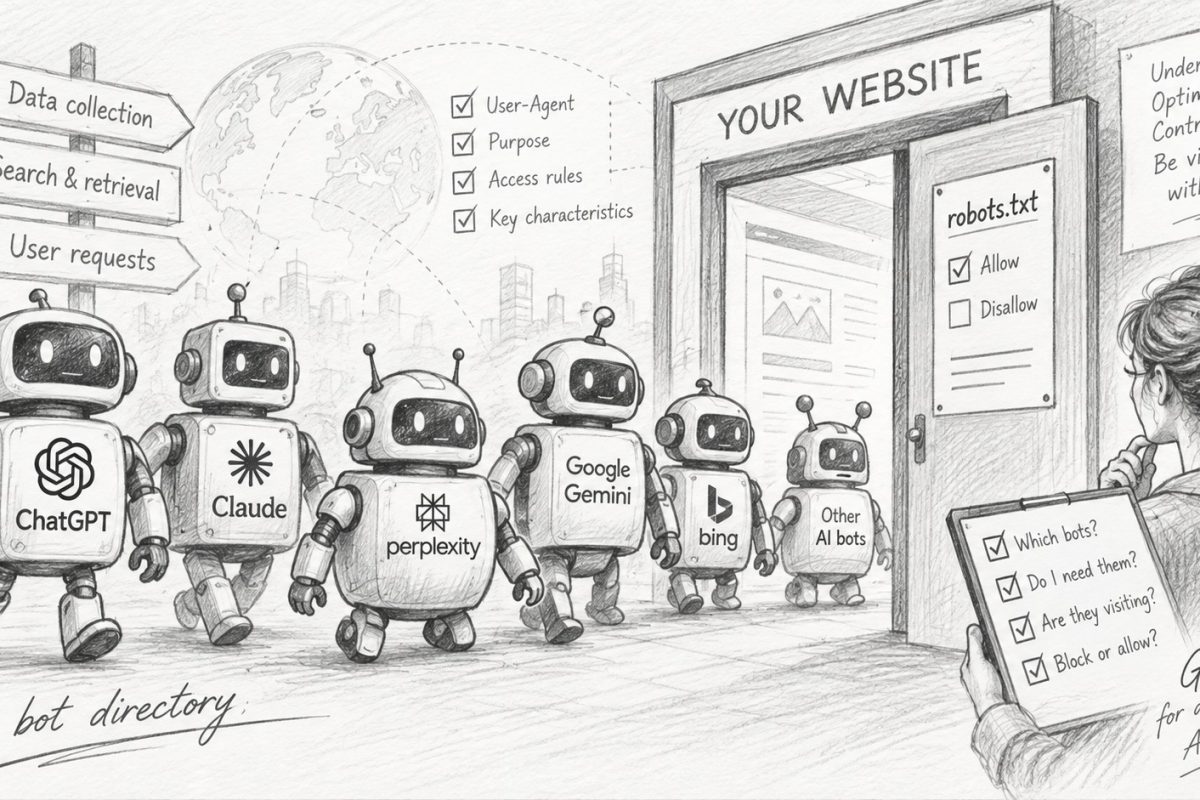
More and more companies are starting to work on GEO and track their brand visibility in ChatGPT, Perplexity, Claude and other AI systems. But before optimizing a website for AI, it makes sense to start with the basics: which AI bots can actually visit your website, what they do, and whether you need them at all.
What types of AI bots are there?
A single AI platform may operate several bots for different purposes. One may be used for data collection, another for search and retrieving up-to-date information, while a third may visit a website in response to a specific user request. Their User-Agents, access rules and behavior can all differ.
At the same time, information about AI bots is scattered across the documentation of different companies. Their names are easy to confuse, their purposes can change over time, and some AI platforms do not have a publicly confirmed identifier for their web traffic at all.
We’ve tried to bring this information together in an AI bot directory. For each bot, we collect the available technical information:
- which platform it belongs to;
- which User-Agent it uses;
- what it is designed for;
- how its access to websites can be controlled;
- and which specific characteristics are important to consider.
If there is no officially confirmed information about a particular parameter, we say so rather than presenting our own hypotheses as established facts.
We do have a few hypotheses of our own, though, and we’ll publish some of them in the blog from time to time. They probably won’t make it into the official bot directory.
The directory will keep changing
The AI bot ecosystem is evolving very quickly. While we were putting together the first version of the directory, the data changed a few times.
New bots appear, User-Agents and access rules change, companies update their documentation, and some platforms are only beginning to describe their infrastructure publicly.
That’s why the AI bot directory is not a static table. We’ll continue updating it as new, verified information becomes available.
Why do you need an AI bot directory?
The directory helps you understand which bots your website allows or blocks at the robots.txt and infrastructure level. But that is only the first part of the story. There is a big difference between “this bot can theoretically visit a website” and “this bot is actually visiting your website.” We have already encountered a case where everything was configured correctly in robots.txt, but the hosting provider’s security module was blocking requests from AI bots. There were no visible signs of the problem for the website owner: the site was working normally, search engines continued to index it, and its SEO metrics remained stable.
This is exactly why at ELNIQ GEO we separate two things: reference information about known AI bots and actual bot visits to a specific website. The first helps you understand which bots exist and how they are supposed to work. The second shows you what is actually happening on a particular website. That’s where our platform comes in.
Before building a GEO strategy, it’s worth understanding which bots should have access to your website and which ones may be useless – or simply unnecessary – for your website and your business. You can block those bots to reduce the load on your infrastructure.