
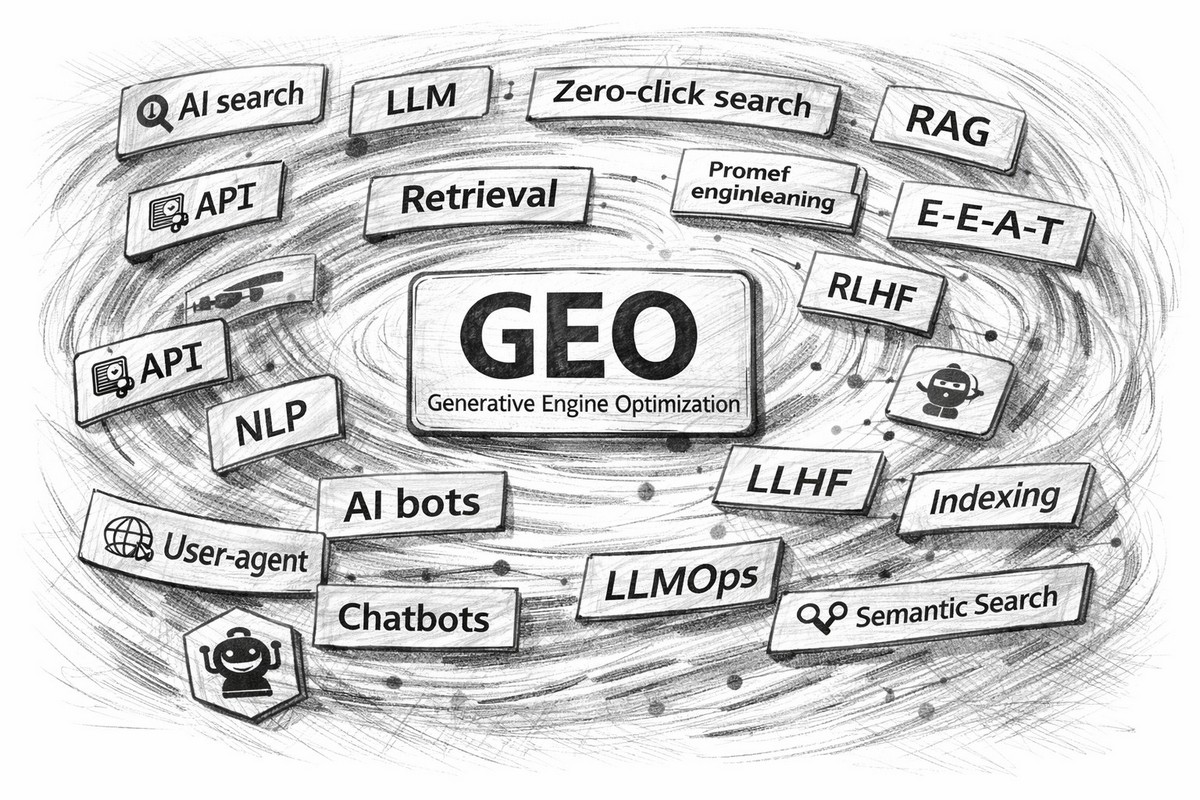
2025 was a turning point. By mid-year, the trajectory of AI-powered search had become clear; by year-end, the first strategic frameworks were taking shape. But this is still a young field, and – as always at the dawn of a new discipline – the terminology is a mess. We won’t claim these definitions are definitive, but we’ll do our best to bring some clarity. We’ll also update this article as the field evolves.
Here are the terms you’ll encounter most often.
Fundamentals
GEO (Generative Engine Optimization) – optimization for generative AI systems and AI-powered search. Think of it as SEO, but for AI (ChatGPT, Google AI Overviews, Perplexity, DeepSeek, Microsoft Copilot, etc.). For the record, these are distinct systems:
- ChatGPT – conversational LLM interface.
- Google AI Overviews / Gemini – search engine with integrated AI blocks.
- Microsoft Copilot – assistant + search.
- DeepSeek – model/platform.
- Perplexity – AI search with source citations.
- Etc.
AI search – the act of searching via AI systems, or the environment in which that search takes place. Meaning depends on context.
AI SEO – used in two distinct ways: (1) a synonym for GEO, i.e. optimization for generative systems; (2) the use of AI tools within traditional SEO workflows. These are very different things. When referring to the optimization process itself, GEO is the more precise term.
AI response / AI output – the answer generated by an AI system in response to a user’s prompt. Also referred to as a generative answer, AI overview, or AI response.
Prompt – a user’s input to an AI system. Unlike a search query – which essentially means “find” – a prompt can mean “find,” “write,” “analyze,” “summarize,” “compare,” and much more. That broader scope is exactly why “prompt” shouldn’t be reduced to “query.” They’re not the same thing.
LLM (Large Language Model) – the underlying model powering an AI system. Each AI platform has its own model family – GPT-4o, o1, o3 for ChatGPT; Gemini 1.5, 2.0 for Google, and so on. When you run a task, you’re working with a specific model, not “the AI” as a whole.
Zero-click search – when a user receives an answer directly within the search interface, with no need to visit an external site. This is the central challenge for publishers, site owners, and SEO professionals – and it’s become significantly more acute since Google and others introduced AI-generated answers into organic results.
AI Overviews / Generative answers – see AI response / AI output above.
Source attribution – the mechanism by which an AI system credits the sources used to construct its response. Attribution may appear as a clickable link, a brand mention, or a non-linked textual reference.
Note: source attribution does not guarantee traffic – it isn’t always a link. But it does signal that your site is recognized as an authoritative source, which carries its own brand value.
GEO-Specific
AI visibility / AI presence – the degree to which a brand, website, or area of expertise appears in AI-generated responses, as opposed to traditional search results. It reflects whether AI systems recognize your brand and draw on your content when generating answers. Measuring this is one of the core functions of ELNIQ GEO platform.
AI Share of Voice – a brand’s share of presence across AI-generated responses, relative to competitors. The generative-search equivalent of traditional Share of Voice – applied not to SERPs or paid media, but to AI outputs.
Being a source vs. being a link – a meaningful distinction in generative search:
- Being a source – your content is used by the AI to construct its answer.
- Being a link – your site appears as a clickable option for the user to explore further.
The prevailing view is that being a source is more valuable than being a link in generative search. Not everyone agrees – and it’s a live debate among SEO professionals and business owners alike.
Retrieval – the process by which an AI system selects and extracts content fragments from available sources before generating a response. Retrieval happens before text generation, and it’s at this stage that the question of which sites get used is decided.
RAG (Retrieval-Augmented Generation) – the architecture underlying most AI search systems, in which responses are constructed by:
- retrieving relevant content from external sources,
- generating text on top of that retrieved data.
In short: find first, then generate. Some systems skip true generation altogether and instead compile and surface existing answers directly.
Content & structure
Passage-level retrieval – the extraction of specific content fragments – paragraphs, lists, definitions – rather than entire pages. AI systems read sites selectively and non-linearly, which means content structure directly impacts visibility.
Entity-based search – an approach in which AI works with entities (brands, people, products, concepts, and the relationships between them) rather than keywords. The more clearly a site defines its entities and their context, the more effectively AI can interpret and use it.
Topical authority – a site’s depth and consistency of expertise on a given subject, rather than optimization for isolated queries. In the context of AI, topical authority matters because generative systems tend to favor sources that cover a topic comprehensively and consistently over time.
E-E-A-T (Experience, Expertise, Authoritativeness, Trustworthiness) in the AI context – the trust signals that AI systems factor in when selecting sources. In generative search, E-E-A-T doesn’t influence rankings in the traditional sense; it influences the probability of being used as a source.
Infrastructure
AI crawlers / AI bots – bots used by AI systems to access websites, refresh data, and extract content for generative responses. They differ from traditional search crawlers in both purpose and behavior.
User-agent (AI) – the identifier an AI bot presents when accessing a site. Servers, firewalls, and site configurations can use user-agents to allow or block AI crawler access.
robots.txt for AI bots – the robots.txt file can permit or restrict AI bot access, but it does not guarantee that content will be used – or ignored – in AI responses. Access and usage are two separate things.
Indexing vs. ingestion – a critical distinction:
- Indexing – the classic process of search engines cataloguing your pages.
- Ingestion – the process by which content is absorbed and used by a generative model.
A site can be indexed by search engines without being ingested by AI systems, and vice versa. “Ingestion” is not yet a fully standardized term in the industry, but no better alternative has emerged.
We hope this helps cut through some of the noise in an industry that’s still finding its footing.
We’ll keep updating this article as the field develops.